Episode 45: Engineering the future with Earth’s oldest materials
In this episode, we talk to Arash Hosseini, Ph.D., P.E. and Matthew Ridgway, P.E. of Terracon about what it takes to make site-specific measurements consistent, accurate, and scalable.
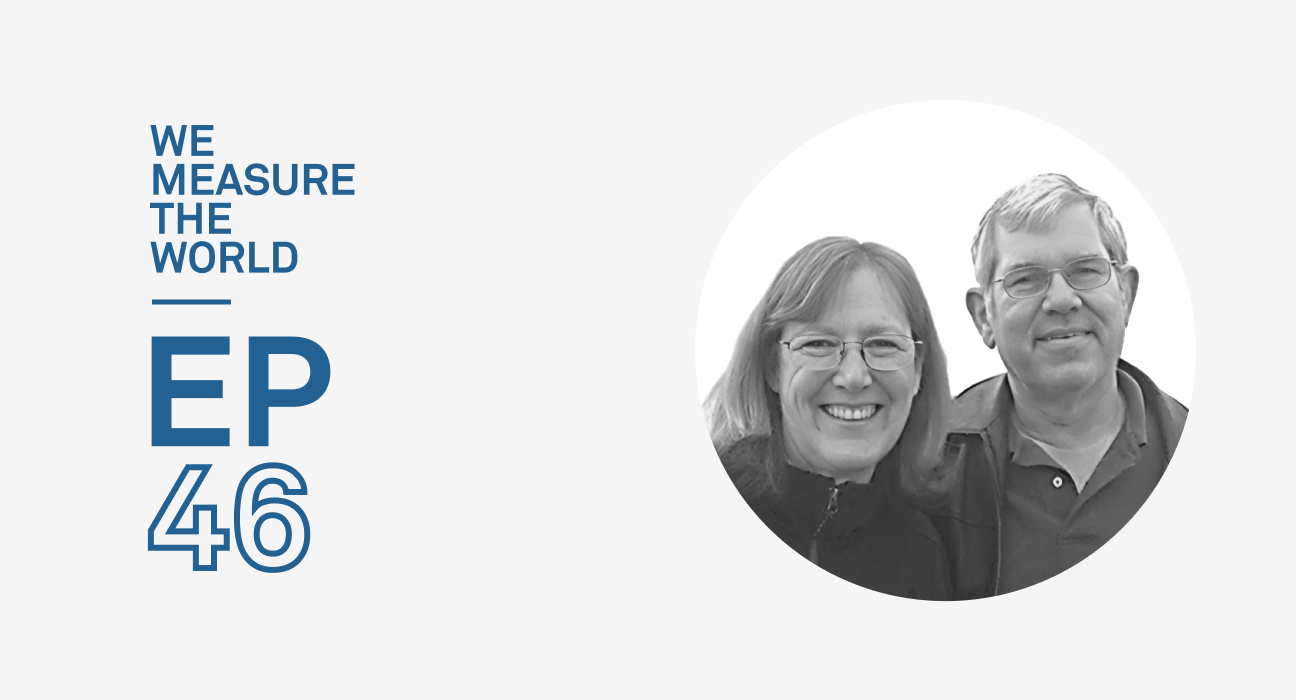
From pioneering instrumentation at Yucca Mountain to developing regional and global models that inform water management and climate risk, Drs. Lorrie and Alan Flint have demonstrated the importance of long-term data, interdisciplinary collaboration, and the evolving role of science in public decision-making. In this episode, we sit down with the Flints, retired USGS research hydrologists and current co-directors at Earth Knowledge, to explore their decades-long journey through soil physics, desert hydrology, and climate modeling. They discuss the challenges of scaling models across diverse environments, integrating remote sensing, and their commitment to mentoring the next generation of scientists.
Lorrie and Alan Flint obtained their PhDs in Soil Physics from Oregon State University and spent their careers as research hydrologists with the US Geological Survey, both recently retiring with Emeritus status. Initially working in desert landscapes, they developed measurement systems to characterize meteorology, shallow soil processes, and the deep unsaturated zone; as well as mechanistic models to simulate those processes across large landscapes. They now serve as Co-Directors of Earth Systems Modeling at Earth Knowledge, a data analytics and climate change risk company, where they continue to generate models and investigate influences of climate change in California, the western US, and throughout the globe.
Our scientists have decades of experience helping researchers and growers measure the soil-plant-atmosphere continuum.
Disclaimer
The views and opinions expressed in the podcast and on this posting are those of the individual speakers or authors and do not necessarily reflect or represent the views and opinions held by METER.

Receive the newest content on a regular basis.
In this episode, we talk to Arash Hosseini, Ph.D., P.E. and Matthew Ridgway, P.E. of Terracon about what it takes to make site-specific measurements consistent, accurate, and scalable.
Germany has committed to generating 80% of its electricity from renewable sources by 2030, as outlined in the Climate Action Act.
Road construction projects can thrive or fail based on the weather conditions they face. In this episode, Bryce Wuori, Co-founder and CEO of Pavewise, discusses their development of software designed to make weather tracking simpler for the road construction industry.
BRAD NEWBOLD 0:00
Hello everybody, and welcome to We Measure The World, a podcast produced by scientists for scientists…
LORRIE FLINT 0:07
We’re sitting in a meeting, and the guy who operated Hetch Hetchy, Bruce McGurk, he says, I don’t understand this is back in like 2006 there’s no water in our reservoir. So we pulled up our little data, and within about 10 minutes, we were able to say, Well, that’s because it snowed on dry soils. Our data was showing that so it was filling up the soils instead of going into the reservoir. And this was a key observation that we’ve now taken throughout California.
BRAD NEWBOLD 0:35
That’s just a small taste of what we have in store for you today. We Measure The World, explores interesting environmental research trends, how scientists are solving research issues and what tools are helping them better understand measurements across the entire soil, plant, atmosphere, continuum. Lorrie and Alan Flint obtained their PhDs in soil physics from Oregon State University and spent their careers as research hydrologists with the US Geological Survey, both recently retiring with emeritus status. Initially working in desert landscapes, they developed measurement systems to characterize meterology, shallow soil processes and the deep unsaturated zone, as well as mechanistic models to simulate those processes across large landscapes. They now serve as co-directors of Earth Systems Modeling at Earth Knowledge, a data analytics and climate change risk company, where they continue to generate models and investigate influences of climate change in California, the western US and throughout the globe, and today, they’re here to talk to us about their work in developing scientific tools to guide water management and landscape resource planning in the face of climate extremes. Lorrie and Alan, thanks so much for being here. All right, so today, we definitely want to talk to you about your careers, some of the projects you’ve worked on, your research interests. But first, can you tell us a little bit about your backgrounds and how you got into this intersection of soil science, hydrology and data modeling?
ALAN FLINT 1:56
I started out in high school building instruments to measure wind speed from electric motors that would if you go backwards, they would generate electricity. And my brother and I built one, and that was my first wind speed sensor. But I ended up going to the Air Force learning how to do instrumentation on big airplanes. And I learned how to do that. I spent a tour in Southeast Asia, and when I got out of the Air Force, I wanted to go to college. And when I went to college, I learned how to measure things and how to do instrumentation. And my major professor worked for Gaylon Campbell, who is a METER Group, and I learned about instruments and measurements and how to interpolate between sensors that were spatially distributed to use numerical modeling. And that’s how I got into the business doing this work. And I was sort of discovered by the US Geological Survey as somebody who knew how to do measurements and modeling, and they wanted me to work on the nuclear waste site at Yucca Mountain, determined whether it was suitable for nuclear waste, and so they hired me, and I went to work there. What’s kind of funny is that they ask the guy that was running the project asked for two people. He said, I need somebody with a PhD in soil physics, and somebody has a master’s in soil physics that can run a soil physics lab. And at the time, my wife Lorraine, was running the soil physics lab at Oregon State University, and he said, boy, do I have a job for you guys.
LORRIE FLINT 3:29
Little did we know we were going to get on busses and go out into the middle of nowhere every day. So I started out as an art major, decided to go into wildlife. Couldn’t get into grad school for wildlife because he didn’t have any jobs available, so they weren’t letting anybody in. So I started putting together thermocouple probes in Alan’s professor’s lab to get paid and get some experience. I thought, wow, this is kind of cool being able to measure things in soil. So I ended up getting a master’s in soils. A number of years later, got the PhD. I actually got to Yucca Mountain before he finished his PhD, and rode that gang bus out to Mercury, out into the middle of nowhere, and decided it was actually soil physics, but it was, it was hydrology. We were, we were trying to understand net infiltration and meterology. We had no preconceived notions of how the desert worked. So it’s not like we brought anything to the table that was going to bias our interpretations of what we observed. And it ended up being an extremely useful perspective to be able to not think all the water was in the channels, for example. And so we were able to look at things regionally and determine what mechanisms were responsible for things in a very fresh way. And I think it really helped us in the Yucca Mountain project to come up with new and innovative ways not just to measure things, but to interpret things, because we we didn’t have a library either.
ALAN FLINT 4:57
I think that’s a really important point. Lori makes, and that is, when you go into a scientific investigation, preconceived ideas of what the results are are not a good thing to take with you. You need to go in there with what is the question you’re being asked to answer? What are the basic principles and understanding that you have? What data do you have available to you. What can you actually add to the measurement world? We were told when we went to Yucca Mountain and we were going to spend $2 million on boreholes, they said, Oh, put them in the channels. That’s where the recharge goes. No, it’s not. 90% of the recharge does not go in the channels at Yucca Mountain. We learned that because we didn’t listen to what people told us they thought. We thought about what we thought we could do, and so having preconceived ideas not good. Having measurements, having data is really good.
LORRIE FLINT 5:55
Yeah, the other key in the desert environment, you have to have long term data.
ALAN FLINT 5:59
It doesn’t rain every year.
LORRIE FLINT 6:01
Right, there’s not infiltration every there’s not infiltration every year. In order to interpret things, you have to have long like we had 99 bore holes that we that we measured every month for 10 years. And it wasn’t until the ninth or 10th year that we saw repeated instances where we could interpret what the mechanisms were.
BRAD NEWBOLD 6:21
I wanted to dig into the significance of that location and why you were there, why the US Geological Survey was there, what was the whole purpose of that project and its background?
ALAN FLINT 6:32
The background is that we work for the nuclear hydrology program out of the Denver office of the US Geological Survey, because the USGS was studying the Nevada Test Site where they were blowing up nuclear bombs, and they wanted to know about contamination of water, contamination of groundwater. And so we were there because somebody in the US Geological Survey recommended Yucca Mountain as a good place for burying nuclear waste, high level nuclear waste, because they had studied nuclear waste for a long time, and they thought, because of the low rainfall amounts, that that would be a good place. And so when I got hired by the US Geological Survey, they sent me to Nevada to say whether or not I could figure out what the infiltration rates were, because the engineers said more than a millimeter a year of net infiltration over the nuclear waste canisters that they were going to bury underground would cause them to corrode, and that would cause contamination, which would end up in, ironically, Death Valley. And when we got there and we did our studies, we found out that the average infiltration rate was 17 millimeters a year. That was going to cause catastrophic failure of the waste canisters. But the idea was to understand how water flowed through the mountain, and how much water flowed through the mountain. And so we started doing surface infiltration measurements. We started doing Unsaturated Zone instrumentation and measurements to try to understand how water flowed. And we had a it was a about a two kilometer by two kilometer area, and it was in the middle of the desert. And like we said earlier, it doesn’t rain that much. Kind of a funny story is that when we first got there and we were studying the infiltration information from bore holes that were measured before we got there, we saw things in bore holes. It wasn’t for six or seven years later, when we had a major infiltration event, that we realized what had happened in the past, that they had big runoff events before they built the boreholes, one of the ones that we looked at. And so we realized that you had to have many years of data before you could understand how things happened. So the time series was really critical to us.
LORRIE FLINT 8:56
So this, this a whole, whole process here was kind of cool, because we had to characterize all of the processes, right? So we had meterology, had a whole bunch of weather stations up meter and stuff soil radiation and evapotranspiration, and then we had soil moisture measurements for surface infiltration. We did ponding experiments, and then we got to go. They drilled this big hole in the ground that was going to be the the exploratory tunnel before they would then off of that, they would have tunnels for high level nuclear waste canisters, but we got to go under underground and measure what was happening underground. So you could then imagine having a ponding experiment on the surface of the mountain, and then being in a an alcove, being able to measure what actually got through. It was an amazing opportunity to do things that most people don’t ever get get to do yeah and and be able to say, oh yeah, I can write a paragraph and get a million dollars from DOE because it was so nationally important.
ALAN FLINT 9:59
One of the questions they asked us was, they said, how much water are we taking out of the mountain through the ventilation system as we run our tunnel boring machine? So we went in on the back of the tunnel boring machine, and we had little drill holes into the rock, and we put in heat dissipation probes, the heat dissipation probes that we put in to measure what the water content was as soon as we drove through the mountain. Actually, it was a ceramic that was developed by Gaylon Campbell at Washington State. And then Gaylon and I wrote a paper on how to calibrate them and publish that. But we put them in the mountain, and we could tell them, because I took my weather stations off of Yucca Mountain, put them inside the tunnel to measure the air flow and the relative humidity and how much water was leaving the mountain, so we could calculate that. We worked with Lawrence Berkeley Labs, Lawrence Livermore Labs, Los Alamos National Labs, Sandia National Labs, all together, all of us, all scientists, all working together on this, and that was a really good collaborative of people trying to understand and we could tell the Department of Energy what was happening in the mountain, because we had measurements and we could model it. And those were really key to putting everything into context to understand how the system worked.
BRAD NEWBOLD 11:19
As you’ve been talking about all the different measurements and instrumentation that you’ve been using. Can you talk a little bit more about the significance of being able to have these multi layered systems so you’re dealing with, you know, weather measurements, you’re dealing with trying to measure the energy balance, or soil moisture, evapotranspiration, all those kinds of things. Can you talk a little bit more about about the significance of combining all of those measurements into these kind of final results that you are getting?
LORRIE FLINT 11:46
Our goal was to assess net infiltration, or recharge right and recharge you can’t directly measure over a very large area. So you have point measurements, you have deep measurements, you have measurements of things like temperature fluxes that give you ideas of a certain volume of area, water chemistry, there’s water chemistry, heat flow. So then all of those things have to be represented by numerical models that allow you to say, okay, we can explain all these different measurements that are of different that assess different scales of processes, we have to be able to fit that into a numerical model, to to be able to distribute it beyond those points. There has to be able to explain
ALAN FLINT 12:34
them all. Yeah, there’s a natural geothermal gradient from the Earth’s core deeper down, and then there’s a surface measurement of temperature and rainfall, and that temperature is going to go through the soil, and it’s going to change the temperature in shallow boreholes or deeper boreholes. And we use that information to tell us how much water was flowing by looking at the borehole temperatures that were measured over years to give us an idea. And one of the things that we did is we published a paper not that long ago, maybe 1015, 20 years ago. Now that’s that basically said. Here’s how we interpolate information in terms of the spatial distribution of data and understanding. Oddly enough, we were called by research group in Israel that was trying to do work on recharge in the deserts in Israel. And we’ve also done work in Iraq, and we’ve done work where they said, how do we think about this? And so we’ve taken this information and we’re trying to extrapolate it to other countries and other people to know how you do this. So I reviewed a paper that somebody wrote about, how are we going to do recharge, and they’re going to get a lot of money to do this study. And so we try to provide that information. And so having this experience and sharing it with other people is really critical to us, which is why we’re here, because we’ve learned a lot in working in the desert environment. And then Lorrie and I, on our way from Las Vegas to go up to Lorrie’s brother, who lives in Oregon, we’re driving through the Central Valley of California, and we said, Oh, does our model apply to California. And we said, oh my gosh, yes, we could use that in California. We can take this to California. And as an aside, we were paid to do the Desert Southwest. And we said, well, can we add California? And they said, Oh no, we don’t have any money for California. We went ahead and did it anyway, but we took the GIS and we hid the California part of our work so nobody that was work we were getting funded by would know that we’re actually doing California at the same time. And then when we got to California, they said, Oh, can you do this here? And we laughingly said, yeah, I think so. But we already knew we could.
LORRIE FLINT 14:57
Developing tools in an area environment means that you don’t have things like stream flow, which is the integrator of all of your hydrology, right? You don’t really have that. Or it happens once every five years. The modeling tools we developed were really based on other kinds of things that, as a compilation, would allow us to, like all these other tools we were talking about, the temperature and the chemistry and things like that allow us to then calculate the hydrologic signature. When we came to California, all of a sudden there was water, and we applied it. First thing we applied it to, for example, was the Tuolumne River. And we thought, Wow, it really works. And we didn’t know that it was going to work. It was a really amazing to be able to then take those tools in an arid environment and be able to apply it to all these other because California’s got the most diverse climate of any any place, really, and we could then try to calibrate to all of different locations and climates in California was really a wonderful process to go through.
ALAN FLINT 15:59
California has political boundaries, but we didn’t have political boundaries. We had hydrologic boundaries. And so we wanted to make sure that we didn’t stop a river halfway through the state of Oregon to come into California, because we needed to know how much water was coming in for the native population, for salmon runs, Indian groups that lived there, relied on those, and so we wanted to make sure we captured all of that for the Native Americans that were relying on that.
BRAD NEWBOLD 16:27
You’ve talked about rivers and watersheds and things right now, but you’ve also worked with snow pack processes in Yosemite. You’ve worked with biodiversity monitoring there at the Pepperwood Preserve there in Northern California. How have these varied projects? Have they complemented each other and in in your research, have they kind of built one upon the other in any way?
ALAN FLINT 16:49
One of the things that started us out on this regional hydrologic modeling is that we were tasked by the US Army for reconstruction in Iraq after the Iraq War. And they said, Can you build a model of the Tigris and Euphrates River system so we can determine how we can resupply water to the wetlands at the bottom of the Tigris and Euphrates? That’s where we started developing these regional scale models. And we realized that we can do regional scale modeling in order to try to address this. Now, given that we didn’t have a lot of data, a lot of the guys that went from our Nevada office into Iraq had to wear these big body suits so they wouldn’t get blown up, and then we couldn’t find out how much water Turkey was delivering, we used the army to give us satellite data so we could see the reservoir filling and emptying over time, and we could calculate how much water they were delivering, because they controlled the headwaters of the Tigers and Euphrates. For the most part, that was how we kind of started this, and realizing that when you do regional work, you need to have other people involved, whether it’s Nevada, Oregon, in California or Mexico.
LORRIE FLINT 18:03
In order to be able to develop those models, you have to understand the processes, because the models are mechanistic. We came to California. One of the first things we did after Yucca Mountain shut down was to get together with the people that were doing the hydroclimatology in Yosemite. We got to put our heat dissipation probes underneath melting snow, so we could understand something about soil moisture and how snow melt processes worked. We also went from doing it a couple of places along the Tuolumne Tioga Pass Road, and the process of doing that worked with the hydroclimatology people we’re sitting in a meeting, and the guy who operated, Hetch Hetchy, Bruce McGurk, he says, I don’t understand this is back in like 2006 there’s no water in our reservoir. So we pulled up our little data, and within about 10 minutes, we were able to say, Well, that’s because it snowed on dry soils. Our data was showing that, so it was filling up the soils instead of going into the reservoir. And this was a key observation that we’ve now taken throughout California. DWR has really jumped on it too, because now they think that soil moisture is a really key component of being able to forecast what’s going to happen when the snow melts. They measure the snow, but they don’t know if it’s going to get into the reservoirs, which is really the key to use those measurements to control the modeling that then allows us to forecast what’s going to happen when the snow melts.
ALAN FLINT 19:28
We update this model every month for the Department of Water Resources in California, and we look at forecasts out and we’ll ask the state climatologist to say, What year do you think we’re living in now? From now to December, what year is an analog as an analog? And then we’ll run that through our model and say, Well, if that’s the year we’re living in, here’s what you’re going to see by the beginning of the next water year in starts in October. But then here’s we’re going to see through December. We try to tie the forecasting into historic. Meter calibrated data to try to tell them what they might see. And that was a key component. And we produce maps of that every month to say, here’s how much water. Because the snow survey, people in California want to know we have 100 millimeters or 1000 millimeters of precipitation in the snow pack. How much of that are we going to get in reservoirs? We’ll say maybe 45% because the soils are so dry, because it didn’t rain before it snowed, they want to know that information, so that’s an add on from what we learned at these meetings.
LORRIE FLINT 20:31
This has prompted them to put soil moisture sensors at many of the SNOTEL stations that measure the snow pack and then throughout watersheds. For example, The Oroville Dam is a big reservoir. They put soil moisture sensors all through the upper watershed to be able to help understand those processes that we’re currently modeling. But they want to be able to validate those models.
ALAN FLINT 20:55
I think that’s a key component to what we try to do. Have a process understanding of how things work. Then add on measurements, instrumentation, data, data collection, spatially distributed, and then try to use numerical models to fill in the data points between the data instruments and the time series, and put that together to get a big picture of what things look like, to give them ability to plan for stuff they want to know, and they’ve asked us that we want to know how to plan for the future.
LORRIE FLINT 21:27
You know, over the course of our careers, one of the things that has come into play more and more is remotely sense data. That’s a measurement of sorts. It’s not a point measurement or a sensor in the ground, but it’s something that we have more and more been able to use gridded climate data, for example, gridded snow water equivalent.
ALAN FLINT 21:47
Is there snow on the ground or not snow on the ground, and where is it? And we can see that from remote sense data. And then we make our models try to match that data to say, if we don’t think that snow and it is snow, we need to figure out what’s wrong with our model.
LORRIE FLINT 22:02
So that’s become another measurement that is really critical, primarily because it’s available in a time series over discrete points in time, whether it’s daily or hourly, or every eight days or whatever. So we can do time series analyzes, but then it fills in all the places in between points. So it’s a really nice tool not to say that it’s better than measurements. It’s not. Measurements also have issues. If anybody’s ever downloaded precipitation data, you know that
ALAN FLINT 22:30
we had done analysis, and we have Fortran codes we’ve written that look at every station in California, hundreds of them, and we asked the question, if that station isn’t there, what would all the other stations say is there in terms of rainfall or Tmin or Tmax temperatures, whatever? And then we can find stations that you can never match. And then we did an analysis on the stations, and we found out that they were wrong because they had solar radiation above the solar constant, because their instruments were bad, and what turns out to be, and we learned this from working with the water quality control board, is that they give farmers a new sensor. When a sensor goes out, like a solar radiation sensor, they forget to change the calibration value in the data logger, and so it uses the old calibration for the old sensor. And so everything is wild and crazy. And so there’s an idea behind knowing what your data is, where it came from, whether you can rely on it, what are the issues that you have to deal with collect your own data?
LORRIE FLINT 23:31
Does it represent more than just that one point on the planet? Correct? We had a colleague that went around and looked at all of these stations in Northern California. Actually visited them, and son of a gun, if that one temperature gage was getting the exhaust from the air conditioning in a building.
ALAN FLINT 23:47
The Napa mental hospital, they put a station right next to it, and the exhaust was blowing into the station. Or another example is that they had these stations at Davis at the University of California, and it had wind speed and wind direction that we used for years. Then they built a whole bunch of student housing. And after the student housing was built right next to the station, the wind speed and wind directions all changed. I wonder why. Maybe because the housing was there? And so we looked at that kind of stuff. We tried to understand people are changing the climate. People are changing the weather. You go live in Sacramento and you put all this asphalt down, why do you think it’s warmer there? Because of climate change or because there’s a lot of asphalt absorbing the heat. Those are the kind of things that we’re trying to understand. Our relationship with the data that we use and the data we collect. Sometimes models are better than measurements. Yeah, sometimes models are better than measurements. Gaylon, he asked me to go to this tri-society meeting. At the end, I said, let me tell you this philosophy story. As soon as I told this philosophy story, Gaylon jumped up and went to the microphone, and he pointed everybody in the audience and said, listen to this. When I was about 21 I was a sergeant in the US Air Force, and I was stationed in Utapau, Thailand, and. We had C-130s. They were four engine turboprops that we were flying around in Laos and Cambodia, looking for MIA’s, POW’s, whatever we could see. And then we were put on a mission to find American citizens that had been in Cambodia, Phnom Penh at the airport, because the airport had been surrounded by the Khmer Rouge and our C-130’s. One of our C-130’s was in there, but they couldn’t get one of their engines started, the number three engine, which is next to the co pilot side, and so they sent three of us in with our own C-130. I was instruments, avionic, instrument systems specialist, an engine guy and a fuels guy to see if we could figure out what was wrong with their engine, to try to get it started. So we landed, we parked our plane in front of their plane. We got off, got on the plane that wouldn’t start an engine. And said, what’s the problem? He said, well, it’ll crank. The captain said, it’ll crank, but I can’t get it to ignite and fire. I want to see what’s going on. And we said, why don’t you just fly it the way it is? And he said, No, I only have three engines, and that’s not safe. So we said, Okay. So we had our captain of are plane put his all four engines full bore so that we could get the wind off our propellers, to try to get his prop the crank. And we looked, and I’m sitting in the in the in the center seat, looking at the instruments, and I can’t see anything wrong. The fuel guy can’t see anything wrong. So they said, Okay, let’s go out and pull the panels on the engine and see if we can find out what’s going on. And as soon as we started getting off the plane, we heard this huge explosion. We looked around and we could see that they were hitting the ground with these, apparently, 105 millimeter howitzers that the Khmer Rouge had captured. We dropped them a couple days earlier for the Cambodian soldiers, and then a day later, we dropped the shells, and apparently they captured half of them, and half the shells, so they were trying to figure out how to use them and firing at us. And so before we could get to the engine, the captain ran off of the plane and yelled at us. He said, Let’s go. Let’s go. Let’s go. And we said, Well, wait a minute. You said it’s not safe. He said, three engines are more than enough. And so five or six years later, when I was a graduate student, I realized that’s my philosophy about numerical modeling. You may not get it perfect, but sometimes three engines is more than enough.
BRAD NEWBOLD 27:12
One of my questions was about the idea of calibrating and validating your models and and what are some of the ways that you go about doing that to ensure the accuracy, both at a local or a larger regional we’ll get into global stuff in a little bit, but, but Yeah, can you talk a little bit about that process of calibrating and validating?
LORRIE FLINT 27:33
So what we’re using is a water balance model, so it’s got all the components of the water balance, and so we have to calibrate or validate each individual component using PRISM Climate data, for example, then we have to compare that to station data. That’s one thing that we’ve done. The next component is evapotranspiration, and so Alan has compared it to SIMA stations, irrigation management system stations all over the western US, for example, to calibrate the model, we can also calibrate to groundwater models that are using well data, water level data, to run their models. And then we can say how well our inputs to their models work. They have to tweak our recharge estimates a little bit, so now we have an estimate of what the recharge is in different basins. Ultimately, the goal is to match stream flow. Stream flow is a quirky thing, because people take water out of streams and put water back into streams. So we’re trying to do things in unimpaired conditions to get good calibrations and then be able to say, okay, downstream, this is what’s happening. So it’s like modeling things in engaged basins, but you calibrate to a process that is explained in locations that do have good stream flow data.
ALAN FLINT 28:52
Yeah, we did learn that in Northern California when we were having a hard time matching stream flow data. We did not realize until later that the marijuana growers from Mexico take the water out of the stream for their marijuana fields, but don’t tell anybody. And so the water doesn’t make it down to the USGS stream gage.
LORRIE FLINT 29:10
That happened in the Eel River area. And we didn’t know that it was claimed to be an unimpaired gage, right? Right? Yeah and they didn’t know that.
ALAN FLINT 29:18
They didn’t know that somebody was stealing water for marijuana fields, and you can’t go look, because if you do, they have heavily armed people that are patrolling their property. So the USGS will not go there to find out why we’re not getting the data.
LORRIE FLINT 29:32
They try to use aerial photographs.
ALAN FLINT 29:34
They use aerial photographs of that two examples on instrumentation and a calibration. One thing is, what is the solar radiation value? And the way they measured that is, they had a whole bunch of companies that make solar radiation sensors, and they all went to a high elevation area in Switzerland, and they all put all their sensors together, and then they looked at what was the mean, the standard deviation, the distribution who was way off, or who was way over or who was way under, and they tried to come up with a consensus of what the actual values were, and that’s how they determined that. We did that with net radiometers. And we did a whole bunch of net radiometers when we worked at Yucca Mountain, because we had the funding, and we found some net radiometers were way off, and we told the guys that made them, and they go, oh. And then they fixed them. But when we looked at other instrumentation, let’s say evapotranspiration, potentially ET and we have a station in California that’s right next to a station within five miles from a station they have in Arizona, and they were 10% higher than ours for two or three years. And I worked with the woman that was running the station for the University of Arizona, and it turned out that we use what’s called a grass standard. So a shortcut grass standard was a you multiply et by one. They used a alfalfa standard, which you multiply by 1.1 so their station was 10% higher than ours all the time. And they decided, Oh, that’s not good. So they changed theirs to a grass standard. And so then we started matching those are little things that you learn when you cross state boundaries, and how people do one thing in one state and something in a different state.
LORRIE FLINT 31:19
It was a challenge doing this for the whole US. We have a model for the whole us, and we were pulling in all this eto data. We had to ensure by going into all those little details, know, if this kind of situation was giving us, you know, spatially distributed stuff that was not going to match.
ALAN FLINT 31:36
And this is some point that we probably want to make in this is that you collect a lot of your own data, make sure your data is right, but if you use other people’s data, make sure you understand where the other people’s data came from and how they got it, and whether it’s consistent with what you’re trying to do. And there’s a point in time at which, if you’re going to do regional modeling, you’re not going to put the data out there. You’re not going to put instruments out there. I put Eddy correlation stations out in the Yosemite. I put them out in Pepperwood Preserve in Sonoma. I can’t do that everywhere anymore. I can’t.
LORRIE FLINT 32:09
No, you have to have a model that is constrained across a number of environments so that we’re getting the ends of the climate spectrum, and then we use that model to model North America and South America, then we can use some remotely sensed data to make sure that we’re getting the snow processes right and things like that. There’s a point at which you can’t use station data for everything. You’ve got to build something that reflects it and then apply it. You can model the United Kingdom, and they’ve got really good data, but try model in North Africa. Yeah, right. There’s not much to constrain you there.
ALAN FLINT 32:48
It’s just hot.
BRAD NEWBOLD 32:49
Along these lines and in working within California, and you did mention that California is an extremely diverse state in terms of topography and climate. What lessons have you learned about scaling from point measurements up to regional models that then you’re taking and applying to elsewhere throughout the world?
LORRIE FLINT 33:09
Well, we’ve calibrated from Desert locations in California up to very high rainfall locations at places that have snow and places that don’t have snow. So that’s the beauty of California, for example. They’ve also taken it up to the Pacific Northwest, where we’ve gotten detailed calibrations. And the idea that we can match stream gages and evapotranspiration estimates in these different places helps us have confidence in the model. That being said, it’s a little bit iffy when you go to some place like Afghanistan, because the data there isn’t good enough for us to say how well it is. So there are caveats associated with modeling in places that has very poor data. But if you can match in places that is climatically diverse, having coastal processes, mountain processes, deserts and almost rain forests, it helps you think that your tools are actually good. That being said, everywhere you go, you have input data, right? So we have soils data. For example, soils properties. Those soil properties are relying on if we go someplace else, we go to Spain or Afghanistan as an example, the data may not be as good. So whenever you go anywhere else, you’ve got the climate, you’ve got hydraulic properties of soils, you’ve got the potential evapotranspiration and actual so vegetation, species and how much they transpire. That data is all input into the model wherever you’re applying the regional model, and we’re going to not do as good a job in the Yukon probably, as we are in British Columbia, because just data availability and quality, it has to go into models to constrain them.
ALAN FLINT 34:51
Using historic literature value. And this was a study that I think Gaylon Campbell did at Washington State, and that he used the minimum and maximum air temperature to try to estimate what the solar radiation was and how much cloudiness there was. And he did it for three stations around Pullman. And I thought this is a really good idea, so I tried it in a couple of stations in California to see if I could do the same thing he did. Me being a little bit crazy, I did 180 stations, and then I made the parameters that I got out of his equations, and I made a geostatistical map of it, and then I made that map, and then I used it to estimate another 45 or 50 stations that I did not use in my calibration, and I matched them because it worked. His methodology worked, and so we learned to take things that were atmospheric and bring those into a bigger picture, because atmospheric parameters are a lot easier at a higher level, two meters, three meter, four meters above the ground, versus this near subsurface stuff. A guy that worked for me, he I had him run all my little weather stations. We were two meters. And he was giving a talk at a soil science meeting in Las Vegas one day, and they said, well, what are you studying? He said, I’m studying the atmospheric parameters at two meters. And the guy looked at him and said, What does two meters matter? Who cares about that? Bill, my friend said, how tall are you?
LORRIE FLINT 36:20
Yeah, micro Meteorology is a key process that determines the water balance at the surface, right? Because it’s defining the gradients.
ALAN FLINT 36:29
You know, how fast is the wind blowing? It’s meter and a half a second, 1.5 meters per second. Gaylon says that’s enough to cause the disruption of the boundary layer conditions. That’s a key that we learned. He did it, he measured it, he wrote his papers. In case you wondered, we’re a fan of Gaylons.
BRAD NEWBOLD 36:44
We are too up here as well, in what you’ve done. Do you feel that ground truthing is going to continue to be a necessity, at least ground truthing, you know, whether it’s remote sensing or modeling or whatever it may be, or do you think that technology might advance beyond the need for ground truthing.
ALAN FLINT 37:04
I think ground truthing is really, really important, but I think that ground truthing is by a variety of measurements. It’s not one way to ground truth. It’s not one instrument, it’s not remote sensing, it’s not one stream gage. It’s a combination, if you have a remote sensed snow. And they say, oh, here’s 300 millimeters of snow, which they’ve said. And then we go, Well, wait a minute, the rain guys say there was only 200 millimeters of rain. How’d you get 300 millimeters of snow with 200 millimeters of rain? There’s something wrong here. There’s a disconnection between them. And then we try to look at where there is a connection and how they relate to each other. So that’s a really important point, is that ground truthing is important, but you have to have it through different methodologies. You have to have different pieces of information if you have so much runoff, but there wasn’t enough rain to match that runoff. Was that groundwater coming out of the system that was there before, and that’s what’s leading to the runoff. Getting the big picture is really key, from a hydrologic perspective, about understanding where’s the water coming from, where’s the temperature, where’s the snow, where’s the sublimation? How big is sublimation? How much water did we lose? And now they have this idea of a thirsty atmosphere. You’ve probably heard that term the atmosphere is thirsty, so it’s taking on more water. It’s one of those things that we’re trying to better understand and try to investigate.
LORRIE FLINT 38:30
Two points to be made here, the more remotely sensed data we use, the more we have to understand how they actually because they’re just taking some picture of some heat signature, right? And then they’re turning that into something that is a water value. The sensor isn’t actually measuring the water. They’re measuring something else. It’s like vegetation and things like that. So we have to understand what kind of information they’re using to ground truth, but then we also have to recognize that they’re coming up with better sensors and all of those things, and maybe some of those sensors are better than historically, but we also have the influence of climate change, so now we are getting conditions that are outside of this historical..
ALAN FLINT 39:12
Correct that’s right.
LORRIE FLINT 39:13
A parameter. So does that mean we’re now extrapolating our data as opposed to interpolating and it becomes more and more difficult to validate it.
ALAN FLINT 39:23
Unfortunately, some of the politics say things happen a certain way, which isn’t the way in reality they happen. And it was at 5:31am the other day that the stream gates the USGS had in the Guadalupe River blew out because the floods were so high, but they didn’t want to put in a warning system, because it would cost too much money. But the USGS sent out a signal. The National Weather Service got that signal and sent it out to the local community and said, you guys are in deep doo doo, so to speak, nobody got the message when all these warnings come along. The water levels went up by 26 feet in 45 minutes, it blew out our USGS stream gage, the National Weather Service saw it said, Holy Moly, no one was there to answer the phone, and there were no sirens. There was no warning. There was nothing we’ve got to integrate measurements and warning, because as climate’s going to change and things are going to happen, and there’s going to be tornadoes and there’s going to be hurricanes, we need to be on top of it, because we have measurements.
BRAD NEWBOLD 40:27
We can transition now to your current work with earth knowledge, and Earth Knowledge seems like a deeply collaborative organization. How has it been transitioning from your work and your careers at the USGS to now joining a data analytics and climate risk company such as Earth knowledge? And can you tell us a little bit about what you’re doing now, what you’ve taken from your previous career, and how you’re applying that now?
ALAN FLINT 40:54
I’ll give you a introduction to how we got onto Earth knowledge. The guy that started Earth knowledge, he and his wife. He used to work for the US Geological Survey. He did the model for the Death Valley Regional flow system. He went to our offices in USGS and asked us, we worked for him. And we said, no. He came back about six months later, and he said, well, you guys did all this work. You did you did a whole model of Brazil, you did Central America, you did the Tigers Euphrates River system, and I’m trying to set up a company that does global modeling of hydrology. Oh, and you also did South Korea for them. You want to work for me? We said no. And then he brought his wife over, and they sat down in our living room, and they had this chart that said, here’s where all the places are, and here’s where you guys would fit in. We really need to save the planet. Do you want to work for us? Okay, okay, okay, we’ll work for you. And because we had done global modeling, and we knew how to take global data sets that we had done, we had worked with people in France, people in Iraq, people in Brazil, and we went to Brazil, we met with them, they taught us what they could tell us about the Atlantic Forest. So we said, Yeah, okay, fine.
LORRIE FLINT 42:02
So your question also those, how did we transition working for the USGS was a an incredible career. It was an unbiased organization that people look to the USGS for the best data.
ALAN FLINT 42:18
Yeah, USGS never managed any land.
LORRIE FLINT 42:20
Never, manage anything, any legislative compensation for making a certain decision. So we were, we would be brought into places where there was a challenge. Some consultants would say, yeah, there’s lots of groundwater there. They’d bring us in, and we’d say uh uh.
ALAN FLINT 42:35
Yeah. The court, the courts would actually ask the USGS. They said, if you want to know if you’re going to present this, get the USGS to give you an analysis, because they’re unbiased. They have no management constraints. They have nothing other than science.
LORRIE FLINT 42:50
So everything that we did was in the public domain. It was free. You had, of course, it took a couple of years to get it there, because of all the review processes, right? So this was a big challenge for us to go from that kind of a of an organization to a for profit company where there’s intellectual property that can’t just be handed out. It’s been a challenge for us to make that transition, that being said, the ability to have more of an impact. It’s a startup company still. We’ve only been doing this for three years now, but the potential to have a big impact is greater. So we feel like the collaborations that we’ve brought in, we brought in people from the IPCC, White House Climate Group, we’ve brought people from solid science, well known people that have lots of different experiences, and there’s all of these people have all these contacts worldwide, and we’ve been able to develop models that are global, that the company can then overlay somebody’s assets and be able to say, what is the risk for those different assets, and then those people can make wise choices globally on what to invest in and what not to invest in on the basis of climate risks or hydrologic risk.
ALAN FLINT 44:10
Yeah, an example is a company said, Well, we’re going to put a billion dollars into this resort in somewhere in Florida. What do you guys think we would say? Well, do you have a lot of kayaks, because you’re going to need them from the parking lot to your hotel, because you’re going to be underwater in 10 years? And they go, Oh, maybe we don’t want to invest that billion dollars there
LORRIE FLINT 44:30
even things like supply chain stuff, you know, if you’re going to build a factory or a plantation or something like that, you’ve got to be able to get the products places, and those, those kinds of things.
ALAN FLINT 44:42
And is it sustainable? That was the other question. Yeah. Is it sustainable? Sustainable? If you want to cut down half of the forest in Brazil to grow makeup, palm oil for makeup, how long can you do that? And what’s it going to do to the rest of the population? So we try to address some of those questions.
LORRIE FLINT 45:00
The other thing that we’re addressing, for example, we’re working seriously with California in terms of near term and long term forecasting and risk assessments to be able to say what happens post fire, for example, we can take out the vegetation, we can then rerun the model and say, This is what’s going to happen if this area burns, or if you manage it a certain way, if you thin the trees, what happens to the hydrology? To help people make decisions on how to reduce fire risk or how to regenerate headwaters, we’re being able to do those kinds of analyzes that are helping the state government make wiser choices in their natural resource management.
BRAD NEWBOLD 45:42
Are there any research questions that you’re excited to explore moving forward, or are there any emerging technologies or data sources that you’re enthusiastic about integrating into your models?
LORRIE FLINT 45:53
There’s a handful of research questions that are interesting to us. I think that as we move into climate that we haven’t experienced before, being able to adjust the modeling to capture things like more serious droughts, understanding something about the different snow conditions under droughts.
ALAN FLINT 46:14
A thirsty atmosphere, yeah, taking snow away.
LORRIE FLINT 46:17
Being able to incorporate we do wildfire potential modeling and estimate what the potential wildfire risks are, you know, for the Western US, for example, and being able to bring in the conditions that we haven’t seen before, like low humidity, low soil moisture, kinds of conditions that they’re unmeasured, they haven’t had them. We are trying to use our tools to be able to better characterize those conditions that we haven’t experienced before. It’s important, extremely important, to be able to assess the spatial variability of risk for people to be able to manage it.
ALAN FLINT 46:55
I think that’s an important thing for us that we’re trying to do now is we’re looking spatially at how things change that have never happened before. How hot is the hottest place in California? How hot is it going to be next week, when it’s going to be 107 in central California? And getting an idea of we’re going outside of the normal range that we’ve seen, and how does that impact the ecology the plants, the trees, the animals. You know, birds can move pretty easily, but tortoises can’t move that fast. Except my daughter’s tortoise is pretty fast. She’s very fast. Some things can’t move that fast. Redwoods can’t move that fast. And so we’re trying to understand that. One of the things I’m working on right now up until 2019 the PRISM data set, which is a data set out of Oregon State University that estimates gridded climate and they’re funded by insurance companies because they can say, No, you didn’t have a drought to some farmer says, Oh, I had a drought here. So no, you didn’t. You’re just making it up. But in 2019 they changed everything. When we did our analysis of snow melt, parameterization snow accumulation temperatures or melt. We did it pre 2019, so now we’re having to redo the whole thing, and now we’re looking at it using a national, global data set, so that we can match that. And so that’s research that’s running on the computer behind me here that’s trying to come up with the new understanding and information. But we have to relate that to satellite snow data. We have to relate that to run off data, all of that stuff. So yes, there’s new stuff happening all the time that we’re trying to come up with.
LORRIE FLINT 48:31
The other new thing that we’re doing is daily forecasting, like 10 day out forecasting, using the Weather Service forecasts, and being able to come up with metrics of interest as you go from winter through springtime snow mill and then drying out into wildfire season, coming up with the best metrics and visuals to communicate the information to the people on the ground as they’re transitioning into different climate states through the year. Last month, they really cared about how fast it was drying out in different places, the risks were going to evolve the soonest for things like wildfire or landscape stress or trees dying or whatever.
ALAN FLINT 49:16
I think that’s a really important point to get across to people. I’m a scientist. I’m a modeler. I understand conceptually how things happen. But Lorrie is an artist, and putting the science that we do into an art form that you can explain. And as our friend in DWR says, I have to explain this stuff to people that probably never took a class in physics in high school.
LORRIE FLINT 49:39
As scientists, it’s always a challenge to be able to explain it to your mother.
ALAN FLINT 49:43
Yeah, if you can’t explain it to your mother, you probably don’t understand it.
LORRIE FLINT 49:46
But you have to be able to couch it. You can have the detailed science version, but then there’s always the bullet that says, This is what this really means.
ALAN FLINT 49:54
Yeah, there’s the artistry to it and and that’s an important part for scientists, is that you’ve got to get the artistry. Into your language, to understand what you think it means, and then get it into a position where somebody that has a high school education and never took physics.
LORRIE FLINT 50:10
Or as a manager or manager or a politician, we have to explain this stuff to Gavin Newsom, right? He’s got to be able to understand it in order to release any funding.
ALAN FLINT 50:19
Yeah, I was, I’ve given tours to the Department of Energy Secretary, to senators, to congressmen, and one congressman at Yucca Mountain when I was there, and I explained to him in very clear terms, he said, I understand everything you said you should be a politician.
BRAD NEWBOLD 50:35
There you go. That’s your next step of your career. There, right?
ALAN FLINT 50:38
No, no.
BRAD NEWBOLD 50:39
What were some of the METER instruments that you were using, or Decagon instruments that you had been using in your previous or current work?
ALAN FLINT 50:46
I was out at Yosemite National Park, and they were putting in a borehole, and they said, well, we want to measure what the water levels are under these Giant Sequoias. And I called up Decagon at the time, and they had these sensors that measured water potential in the ground. They were ceramic. They were these little discs. I said, Have you got any of those that are just laying around that you guys are going to throw away? Can you send them to me? And they said, Oh yeah, we got about 40. So they threw in a box, and they sent them to me, Federal Express the next day, and I had them down in the borehole the next day because I didn’t have any money. I had no funding. I just did it. Decagon, CX two, WP4 instruments. I met with Gaylon about a month or two months ago, and he said one of the funniest things I ever heard was Lori said, If a WP4 had been a man, she’d have married him. We use those things beyond belief. And when we were down in Yucca Mountain, Gaylon, his family came out to visit us in his big van. Well, they ran out of gasoline, so I had to take their van over to the mercury gas station and get DOE to fill their gas up. And I said, Don’t charge it to me, just fill it up. Okay, guys. And he went out to our our laboratory, and we said, here’s the trouble we’re having with the CX two. It’s getting humidity into it, and it’s changing this values. He said, You got a screwdriver. He took the whole thing apart and rebuilt it there in our laboratory to make it work for us, and then he learned to change it in Decagon.
LORRIE FLINT 52:08
We pushed the limits of a lot of the instrumentation. For example, heat dissipation probes, when they originally calibrated, only went to a certain dryness, and we pushed it. And Alan published with Gaylon to take it all the way out to as dry as the atmosphere could get, made it much more useful and unsaturated zone condition, as opposed to, you know, some just wet end soil.
ALAN FLINT 52:29
The history on this is that, you know, Eric Campbell started Campbell Scientific, and Gaylon was his brother. A lot of our original work was done with Campbell Scientific equipment. All our weather stations, all our weather stations and stuff like that. We’re done with Campbell Scientific. But then my major professor got his PhD from Gaylon Campbell, and so I learned instrumentation through him, learned about Decagon, and started getting some of their instrumentation, and we found out some of the stuff they did. You know, their WX2 was made for food industry, and we said, food soils. What’s the difference? Well, we’ll push the limits as best we can. Ended up using it for rocks, and then they ended up using it for rocks, and we learned how to do that. So yes, we used a lot of stuff from Decagon. We bought a lot of stuff from Decagon, put it in the ground at Yucca Mountain. There’s stuff still there, probably at Yucca Mountain, although they may not be measuring it now.
LORRIE FLINT 53:18
We’ve got stuff locally. We took our Campbell Scientific weather station. It’s sitting over in Sonoma County at Pepperwood Preserve.
ALAN FLINT 53:24
We got a surplus to us from the Yucca Mountain project, and then we donated it to Pepperwood Preserve, which was their first station of weather measurements that they had.
LORRIE FLINT 53:33
Currently a sentinel site, another sentinel site with the whole California for climate change climate change sites, yeah.
BRAD NEWBOLD 53:41
My final question would be, do you have any other final thoughts, anything that we didn’t cover, that you’d like to make sure that we touch on any advice for future generations or the general public, or anything along those lines?
ALAN FLINT 53:53
Mentor, I have been working really hard in my career, in the last 15 years to mentor women in science, because a lot of the women that I work with need help living in the USGS man’s world and and so I have put a lot of effort into mentoring women on how to survive and how to do their science, and some of them cringe when I give them books to read that were written by men in the 1950s Oh, that sounds like a man’s work. And I basically say, if you don’t like it, write your own story about women in science. My sister in law, Lorrie’s brother’s wife, is a historian, and he is a historian as well, and they do studies on women in science. And so she’s given me a lot of information, but I think mentoring people and helping people along is really key to taking what you know and passing it on to the next generation. There’s your personal knowledge, there’s your philosophy of science, there’s your history of science, to me, is what I’ve tried to do. Another generation a friend of mine, she’s getting her PhD in University of Nevada, Reno, and I sent her a book on the art of scientific investigation by bevel ridge. I sent it to her because I want her to have a sense of how I got to learn about the art of scientific investigation, and that’s part of where I learned it from.
LORRIE FLINT 55:18
I will close by saying science is being bad mouthed and degraded throughout the national discourse right now, and science is knowledge. It’s how we know stuff, it’s how we make decisions, it’s how we characterize our environment, it’s how we forecast what’s going to happen to us, and I hope that over time, we can revitalize the appreciation of science the necessity, absolute necessity, that we need to fund it. We need to support it. We need to teach our children and we need real things.
ALAN FLINT 55:54
Science comes from the Latin scientia, which means knowledge in Latin, that means we know stuff as scientists, Lorrie and I, being former federal scientists, really need people to understand that federal scientists do stuff. They’re important people, and we can’t just lay them off. I’m a Veterans of Foreign war member. I did my time in Southeast Asia, and they’re laying off 1000s and 1000s of people from the Veterans Administration, which has an impact on me, and I don’t like that. We did our time, we did our service, and as a federal government scientist, we weren’t paid like national laboratory scientists are. You know, when a national laboratory scientist retires, they actually get the salary that they retired at for their retirement. So if you’re making $180,000 you get $180,000 a year as a retiree. I want to support government scientists. I really believe in that, and I want to support science equally well. I think science is knowledge critical to how we’re going to move forward, how we’re going to cure diseases, how we’re going to take care of the fact that nobody had a siren for how we’re going to run off, whether or not we’re going to get or get too much water if you’re in a girls camp, because nobody warned you, because they didn’t want to spend the money to buy a siren. In case you wondered, in case you wondered, we have passion about what we do. We’re passionate about science, about being a scientist, a government employee, all of that stuff, and helping everybody else, moving into the next generation, moving it to men and women. You know, I was a USGS scientist, but I have at least six graduate students that I got through their PhD or master’s programs because I was adjunct faculty, because I cared about moving it forward and moving on what I learned to somebody else, the next generation.
BRAD NEWBOLD 57:38
Well, we appreciate you sharing your passion with us. So thank you very much for doing that. Our time’s up for today. So thank you again Lorrie, Alan, we appreciate you taking the time to talk to us. It’s been a very interesting conversation.
ALAN FLINT 57:51
Thanks.
LORRIE FLINT 57:52
Thank you.
BRAD NEWBOLD 57:53
And if you in the audience have any questions about this topic or want to hear more, feel free to contact us at metergroup.com, or reach out to us on x @meter_env and you can also view the full transcript from today in the podcast description. That’s all for now, stay safe and we’ll catch you next time on We Measure The World.